
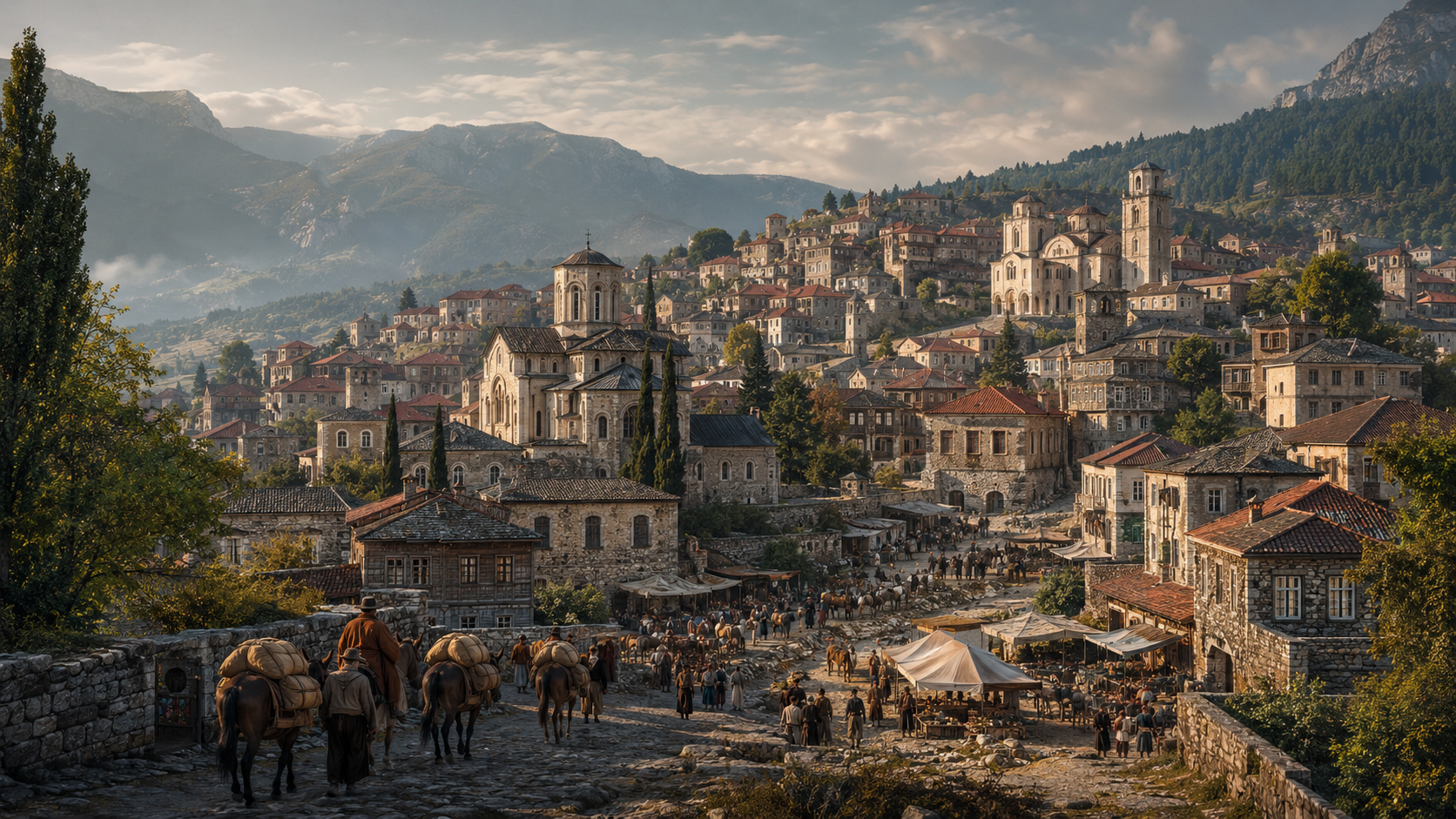
How an Aromanian commercial metropolis became a centre of Greek learning, Balkan trade and Enlightenment before its destruction scattered its people across Europe
Today, Moscopole is a mountain settlement in southeastern Albania, some twenty kilometres from Korçë. Little in its contemporary scale immediately reveals that during the eighteenth century the same place, known as Moschopolis in Greek, Moscopole among Aromanians and Voskopojë in Albanian, stood at the centre of one of the most remarkable urban experiments in the Ottoman Balkans. Its merchants travelled between the Adriatic, Central Europe and the Ottoman interior; its churches were decorated by some of the most important painters of the post-Byzantine world; its schools attracted students from beyond the surrounding region; and its printing house produced books at a time when printing remained exceptionally rare in Ottoman southeastern Europe.
For the Aromanians, or Vlachs, Moscopole subsequently acquired an almost mythical status. It became the lost metropolis from which merchants, intellectuals and families dispersed across Macedonia, Epirus, Serbia, Hungary, Austria and the Danubian lands. Nistor Bardu has described eighteenth-century Moscopole as a metropolis for the Aromanians of southern Albania and Epirus, while later Aromanian collective memory transformed its destruction into the symbolic beginning of a wider diaspora.
Calling Moscopole the “capital of the Vlachs” therefore makes sense only if capital is understood culturally rather than politically. There was no unified Vlach state of which Moscopole served as administrative centre. Nor did eighteenth-century identities correspond neatly to the national categories that Balkan states would later construct. What existed instead was something arguably more interesting: a predominantly Aromanian-speaking commercial city integrated into the Greek Orthodox cultural world and connected economically to a European network extending from Venice to Vienna.
Its history therefore belongs simultaneously to Aromanian history, Greek intellectual history and the history of the Balkans as a connected commercial space.
From a pastoral community to a commercial metropolis
The precise origins of Moscopole remain uncertain. Later local traditions placed its foundation in the fourteenth century, while Ottoman documentation provides clearer evidence only for its later development. Research into its economic institutions nevertheless shows that its roots lay in a pastoral economy associated strongly with Vlach livestock breeding. By the seventeenth century, however, livestock production was generating activities far beyond pastoralism: wool processing, tanning, transport, craft production and increasingly sophisticated commerce.
This transformation is important because the history of the Vlachs is sometimes reduced to transhumant shepherding. Moscopole demonstrates the limitations of that stereotype. Vlach economic mobility created precisely the networks through which pastoral producers could become caravan operators, artisans, merchants and eventually financiers. Asterios Koukoudis has emphasised that early modern Vlach communities included not merely stockbreeders but craftsmen, traders, professionals and entrepreneurs whose activities connected the southern Balkans with Central Europe.
Moscopole became one of the most successful expressions of this transformation. By the early eighteenth century its merchants were participating in commercial routes reaching Venice, Vienna, Budapest and Leipzig. The town developed guilds capable of providing credit, managing commercial risk and organising production. Konstantinos Giakoumis’s research into the local tailors’ guild demonstrates that these institutions were already conducting sophisticated credit-lending operations during the 1710s and 1720s.
Population estimates for the city require considerably greater caution. Older literature sometimes assigned Moscopole populations of 50,000, 60,000 or even more, occasionally describing it as the second largest city of the Balkans after Constantinople. Modern scholarship has questioned these numbers. Koukoudis explicitly warns that claims placing Moscopole immediately behind Constantinople are implausible when compared with centres such as Thessaloniki or Adrianople, while Max Demeter Peyfuss argued that the real population may have been dramatically lower than later legendary estimates. Its historical importance does not depend on exaggerated numbers. Even at a more modest population, Moscopole developed institutions extraordinary for a Christian Mountain city of the eighteenth-century Ottoman Balkans.
A Vlach city whose language of high culture was Greek
The cultural identity of Moscopole presents one of the most interesting problems in Balkan history. Evidence strongly supports an overwhelmingly Aromanian or Vlach demographic character in the city’s core population, although Greeks, Albanians and other groups also belonged to the surrounding social environment. Johann Thunmann, writing shortly after the city’s first destruction, observed that Aromanian was widely spoken, while Greek served an important written and commercial function.
Yet the cultural institutions of Moscopole did not develop in an exclusively Aromanian linguistic framework. Greek functioned as the principal language of education, scholarship, ecclesiastical life and printing. This should not simply be projected backwards as evidence of modern Greek nationalism. In the eighteenth-century Orthodox Balkans, Greek performed a much wider role as the dominant language of higher education, commerce and Orthodox intellectual communication among populations whose everyday languages could be Aromanian, Albanian, Bulgarian or Slavic. Thede Kahl stresses precisely this distinction: Greek already functioned as a lingua franca among numerous non-Greek-speaking Orthodox populations in southeastern Europe.
Moscopole consequently illustrates the difference between language of the household and language of civilisation in the pre-national Balkans. A merchant could speak Aromanian with his family, use Greek in contracts and correspondence, conduct business in several Balkan languages and understand himself primarily through Orthodox Christian communal structures rather than through the exclusive ethnic categories that would dominate the nineteenth century. This is why attempts to classify Moscopole retrospectively as simply “Greek,” “Romanian,” “Albanian” or exclusively “Aromanian” misunderstand the society that created it. It was unmistakably a great Aromanian urban centre. It was simultaneously one of the most significant centres of Greek-language Orthodox culture in the western Balkans.
The New Academy and the “New Athens”
The clearest expression of Moscopole’s intellectual ambition was its educational system. A Greek college was operating in the city by the beginning of the eighteenth century. In 1744, it was transformed into the celebrated New Academy – Νέα Ἀκαδημία – and during the following years developed into one of the leading Christian educational institutions of the Ottoman Balkans. Its curriculum reached beyond elementary religious instruction into philosophy, classical learning and the intellectual currents associated with the Greek Enlightenment.
Figure 1: The School of Moscopole, 1750

The Academy’s most important figures included Sevastos Leontiadis and Theodore Anastasios Kavalliotis, the latter an Aromanian scholar whose career embodies Moscopole’s cultural hybridity. Kavalliotis participated in a Greek-language educational tradition but also recorded the language of the Aromanian population from which he emerged. Moscopole’s reputation as a centre of learning became sufficiently strong for later writers to call it the “New Athens.” Its library acquired considerable renown, while students reportedly arrived from other parts of the Balkans and some subsequently continued their studies in Italy, Austria, Germany and elsewhere in Europe.
This was not merely educational prestige. The Academy turned commercial wealth into cultural capital. Merchants who accumulated fortunes through Balkan and Central European trade financed institutions capable of reproducing an educated Orthodox elite. Moscopole thus demonstrates a pattern found repeatedly in the Greek Enlightenment: commercial diasporas financed schools, books and intellectual exchange, while education strengthened the cultural cohesion of networks that extended far beyond any single town.
Figure 2: The Lost New Academy of Moscopole (Church of St John Moschopolis)

The printing press
If the Academy made Moscopole unusual, its printing house made it exceptional. Established around 1731, although some traditions propose an earlier date, the press was among the earliest sustained printing establishments operating in the Ottoman Balkan world outside Constantinople. Max Demeter Peyfuss’s foundational study of the press identified approximately twenty known publications, predominantly religious and educational works.
The crucial point is that the press operated principally in Greek. This fact has sometimes produced competing national interpretations. Aromanian historiography understandably regards the printing house as evidence of the extraordinary cultural development achieved by a Vlach city. Greek historiography emphasises that the books themselves participated overwhelmingly in Greek Orthodox intellectual life.
Both observations can be true. The press was created and sustained within a city whose population was predominantly Aromanian, while the cultural medium in which its educated elite participated was predominantly Greek. This apparent contradiction disappears once eighteenth-century Balkan society is considered on its own terms rather than through later nationalism.
The intellectual legacy became even more interesting through Kavalliotis. His Protopiria, published in Venice in 1770, contained a vocabulary linking Greek, Aromanian and Albanian, preserving one of the earliest significant written records of Aromanian and Albanian vocabulary. Later, Daniel of Moscopole produced a multilingual lexicon incorporating Greek, Aromanian, Albanian and Bulgarian/Slavic forms. These works have become fundamental sources for historians of the Aromanian language and Balkan linguistics.
Figure 3: Daniel of Moscopole’s Introductory Teaching

Moscopole was therefore not simply a place where one language displaced another. It was a place where several Balkan languages met under the intellectual predominance of Greek.
Churches, art and urban identity
The city’s extraordinary number of churches provides another indication of its wealth. Historical accounts vary over the precise number, but Moscopole possessed numerous substantial Orthodox churches and monasteries, several of which survive today. Among the most important is the Church of Saint Nicholas, built in the early eighteenth century. Its interior frescoes were created by the distinguished painter David Selenica, whose work belongs among the significant achievements of post-Byzantine Orthodox art.
Figure 4: Saint Nicholas Church: A Surviving Monument of Eighteenth-Century Moscopole

Figure 5: David Selenica’s Frescoes in the Church of Saint Nicholas, 1726

These churches were not only religious buildings. They were manifestations of merchant patronage and communal organisation. Guilds, wealthy families and commercial elites financed ecclesiastical art in much the same way that they financed education and printing. The urban community also developed an unusually elaborate system of self-government. Material preserved by the Academy of Athens describes a structure involving six parish representatives, guild leaders and a governing council responsible for taxation, public obligations, communal disputes and aspects of internal discipline. Moscopole was therefore neither an independent republic nor merely an ordinary Ottoman village. It possessed substantial local institutional capacity beneath imperial sovereignty. Economic wealth had produced communal government.
1769 and the destruction of the city
The year 1769 became the great rupture in Moscopole’s collective memory. The wider context was the Russo-Turkish War and the Orlov Revolt in the Greek lands, during which expectations of Russian intervention encouraged anti-Ottoman activity among Orthodox populations. Moscopole’s commercial and intellectual networks connected it to this wider atmosphere of political instability. The city was subsequently attacked and extensively plundered by armed Muslim Albanian groups. The Ottoman state proved either unwilling or unable to provide effective protection. Further insecurity followed, and another major crisis occurred in 1788, during the expansion of Ali Pasha’s power.
It is tempting to reduce the collapse to a single spectacular act of destruction. Recent scholarship offers a more complicated picture. Moscopole had already begun experiencing economic decentralisation before 1769. Successful merchants increasingly established themselves permanently in Vienna, Pest, Buda and other commercial centres. Capital and business networks were migrating outwards even while wealthy expatriates continued financing institutions in their birthplace.
The raids therefore did not destroy a perfectly static metropolis overnight. They accelerated an existing transformation and made return increasingly difficult. Nevertheless, their psychological and demographic consequences were enormous. The city never recovered its eighteenth-century position.
The metropolis becomes a diaspora
Moscopole’s decline paradoxically expanded its historical influence. Families who left the city carried commercial experience, capital, educational traditions and Orthodox communal networks into other parts of southeastern and Central Europe. Moschopolitan and other Vlach migrants settled throughout Macedonia, Epirus, Serbia and the Habsburg territories. Some became prominent merchants, benefactors and intellectuals within the Greek Orthodox communities of Central Europe.
The destruction of the metropolis therefore generated a network of smaller Moscopoles. What had once been concentrated geographically became dispersed commercially. This diaspora complicates attempts to assign a single later national identity to Moscopole’s inhabitants. Their descendants participated in Greek, Romanian, Serbian, Albanian and other national environments. Some retained distinct Aromanian identities. Others integrated into Greek-speaking Orthodox merchant communities and played significant roles in the intellectual and economic preparation of the modern Greek world. Moscopole belongs precisely at this intersection. Its people were among the clearest examples of how mobility could make identity simultaneously local, linguistic, religious and transnational.
Was Moscopole really the capital of the Vlachs?
In a political sense, no. There was no Vlach state, no unified Aromanian administration extending across the Balkans and no eighteenth-century national movement equivalent to those that appeared during the nineteenth century.
Figure 6: Moscopole Today: The Remains of a Lost Balkan Metropolis

But in another sense, the description is difficult to resist. No other Aromanian urban centre of the period combined commercial reach, population concentration, education, printing, ecclesiastical patronage and subsequent symbolic importance on the same scale. For Aromanian collective memory, Moscopole became the lost urban civilisation against which later dispersion was measured. Yet its greatest historical lesson lies precisely in the impossibility of treating it as the capital of a modern nation before nationalism. Moscopole was a Vlach metropolis operating inside a Greek Orthodox cultural system and a trans-Balkan commercial economy.
Aromanian was the language of much of its society. Greek was the language of much of its written high culture. Ottoman institutions provided the imperial political framework. Merchants connected the city to Venice, Vienna and Central Europe. Albanian, Slavic and other populations existed around and within its economic world. Its identity was therefore layered rather than exclusive. That makes Moscopole more, not less, important.
The town’s rise demonstrates how a mountain population associated historically with pastoralism could create a sophisticated commercial metropolis. Its Academy and printing press show how the Greek intellectual world extended beyond populations whose mother tongue was Greek. Its multilingual scholars reveal how porous Balkan identities remained before the age of nationalism. And its destruction explains why Aromanian commercial communities appeared so widely across southeastern and Central Europe during the following generations.
Today, the surviving churches stand among the mountains where a city once connected the Ottoman Balkans with the markets and intellectual networks of Europe. Politically, Moscopole was never the capital of a Vlach state. Historically and symbolically, however, it came closer than any other city to becoming the capital of the Vlach world.
References
Bardu, Nistor. “Eighteenth Century Aromanian Writers: The Enlightenment and the Awakening of National and Balkan Consciousness.” Philologica Jassyensia III, no. 1 (2007): 93–102.
Giakoumis, Konstantinos. “The Voskopoja Guild of Tailors’ Credit Lending Operations and Risk Management (1716–27).” Turkish Historical Review 9 (2018/2019): 242–277.
Kahl, Thede. “Was Bulgarian Spoken in Moschopolis? Reflections on the Use of Slavic in South Albania during the 18th Century.” Study of the multilingual environment of eighteenth-century Moscopole.
Koukoudis, Asterios I. The Vlachs: Metropolis and Diaspora. Thessaloniki: Zitros Publications, 2003.
Martianos, Ioakeim. Moschopolis 1330–1930. A foundational historical compilation drawing upon surviving local codices and communal documentation; material from it is also preserved in the digital repository of the Academy of Athens.
Peyfuss, Max Demeter. Die Druckerei von Moschopolis, 1731–1769: Buchdruck und Heiligenverehrung im Erzbistum Achrida. 2nd ed. Vienna: Böhlau, 1996.
Peyfuss, Max Demeter. “Die Akademie von Moschopolis und ihre Nachwirkungen im Geistesleben Südosteuropas.” In Wissenschaftspolitik im Mittel- und Osteuropa, 1976, 114–128.
Kokaisl, Petr, et al. “Neither Minority nor Majority: The Paradox of Aromanian Identity in the Greek Nationalising State.” 2026. Particularly useful for the historiographical debate surrounding Moscopole as an Aromanian “golden age” and its integration into the wider Greek Orthodox cultural system.