
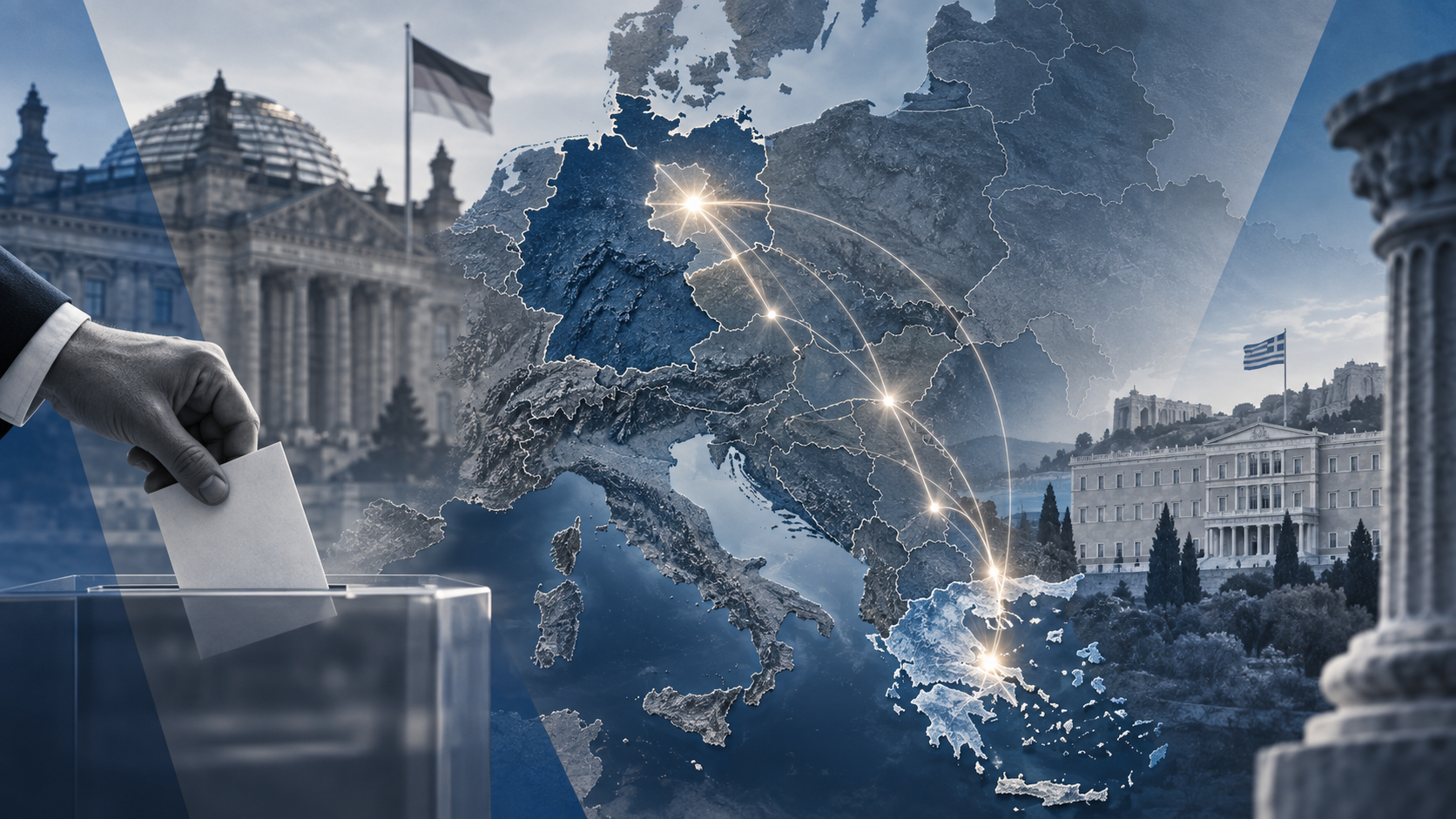
Drawing on the electoral victory of Alternative für Deutschland (AfD) in the state elections of Saxony-Anhalt, where the party received 43.8 per cent of the second vote and secured 39 of the 83 seats in the Landtag, a shift at the centre of Europe appears to be taking shape, one that may begin to spread (Landeswahlleiterin Sachsen-Anhalt, 2026). On the one hand, if the trend of the electorate towards more conservative ideas, and its reaction against what has until now been a progressive agenda, continues, all parties will be forced to adjust to electoral results. If no party achieves a clear governing majority, new forms of cooperation will naturally be explored, as is already the case in the relationship between AfD and the Sahra Wagenknecht Alliance – Reason and Justice (BSW), although the BSW has ruled out a formal coalition with AfD (Fürstenau, 2026). As a result, one may discern something resembling a Hegelian synthesis, where the thesis proposed by AfD and the antithesis represented by BSW could amalgamate into a new level of dialogue and political compromise beyond the traditional parties.
This shift towards realism by parties that have been considered populist points to the fact that even an electorate that is informed and aware of political considerations is not motivated solely by an economically viable political programme, but also by one capable of mobilising and inspiring it. This is particularly significant given the serious questions raised over the financial viability of the AfD programme in Saxony-Anhalt. An analysis by the Halle Institute for Economic Research estimated a financing gap of at least €2.2 billion per year between quantifiable spending commitments and identifiable savings (Dorsch et al., 2026). This is not simply a matter of people turning their backs on established parties, but also of rejecting political idealism, especially progressive proposals on issues of migration, the environment, energy and European unification.
As the electorate rejects the ideas of the parties that have until now led this federal state, the need arises to form a new ideological framework, one that is not simply an agenda designed to attain access to power, whether by traditional parties or protest parties. It should also be noted that parties such as AfD are not entirely self-sustaining ideological projects; much of their mobilising power relies on the existence of an adversary around whom a political programme can be formed. In the case of AfD, this adversary is portrayed as threatening the abolition or erosion of existing structures, in turn creating an impulse to protect those structures as AfD understands them, a turn towards political romanticism.
The intense effort attributed by its rivals to what has been coined the “woke agenda” to deconstruct Christianity and the Enlightenment is, in their view, simultaneously deconstructing European societies and nations. The zeal, as its critics perceive it, to question almost every established right and common understanding, from the level of society down to that of the individual, from gender to other characteristics of identity, resembles, in form rather than substance, earlier antinomian religious movements: the Frankists, followers of Jacob Frank and heirs to the Sabbatean movement, in Judaism (Encyclopaedia Britannica); the Münster Anabaptists in Christianity (Encyclopaedia Britannica); and antinomian movements such as the Qalandariyya in Islam (Salamah-Qudsi, 2018). This zeal can be understood as a secular equivalent of the tendency of such movements to challenge established norms. This version of rejecting existing values, expressed through what its opponents describe as the woke agenda, often employs language that appears almost religious rather than merely ideological or adversarial. It therefore creates new ground for political debate and the production of ideas, while simultaneously suggesting growing distrust towards core values associated with the Enlightenment, Christianity and the Protestant ethic in contemporary Europe. At the same time, it may leave a critical mass of people susceptible to foreign influence and to ideas damaging to their own societies. The desire among the political opponents of the so-called woke agenda is that these ideas and symbols should themselves be thrown into a modern Bonfire of the Vanities, with a self-destructive fervour comparable to that associated with Savonarola’s Florence (Martines, 2006).
As a consequence, the need to form a coherent ideological framework becomes increasingly evident: one capable of standing independently of foreign influence and of generating its own intellectual foundations. The absence of innovative ideas and political thought will not allow societies to recreate and renew themselves and may instead lead to gradual decomposition.
Greek society is fortunate to possess a deep reservoir of ideas in Ancient Greek literature and in the thought and writings of the Church Fathers. In modern Greek historiography, Konstantinos Paparrigopoulos famously articulated a conception of historical continuity linking antiquity, Byzantium and modern Hellenism, making Byzantium an integral part of the narrative of Greek historical identity (Mishkova, 2022). In this sense, a return to values that until recently have often been derided is necessary. The perceived lack of respect for religious symbols, including certain expressions seen in Pride parades, or for national symbols can be interpreted as a sign of moral decline and of increasing distance from traditions that contributed to Greece’s historical dignity and identity.
Without such a return to tradition, a political trend analogous to AfD, although adjusted to Greek realities, may emerge. One possible expression of this protest politics could be a new political vehicle around Ilias Kasidiaris. His lawyer has stated that his participation in forthcoming parliamentary elections through a political organisation is certain, while indicating that formal announcements will follow (SKAI.gr, 2026). Such a development could further fragment the electorate rather than unite Greek society and, as the experience of Saxony-Anhalt illustrates, complicate government formation and place additional pressure on overall political stability.
References
Dorsch, N., Gropp, R. E., & Reifschneider, A. (2026). Ist das AfD-Wahlprogramm für Sachsen-Anhalt finanzierbar? Kosten und Gegenfinanzierung vor der Landtagswahl am 6. September 2026 (IWH Policy Notes No. 2/2026). Leibniz Institute for Economic Research Halle. doi:10.18717/pnhbnc-x191
Encyclopaedia Britannica. Jacob Frank. In Encyclopaedia Britannica. Retrieved September 15, 2026.
Encyclopaedia Britannica. John of Leiden. In Encyclopaedia Britannica. Retrieved September 15, 2026.
Fürstenau, M. (2026, September 8). BSW and AfD – A political love-hate relationship in Germany. Deutsche Welle.
Landeswahlleiterin Sachsen-Anhalt. (2026, September 7). Ergebnisse Landesebene – Landtagswahl Sachsen-Anhalt 2026.
Martines, L. (2006). Fire in the city: Savonarola and the struggle for the soul of Renaissance Florence. Oxford University Press.
Mishkova, D. (2022). The century of history. In Rival Byzantiums: Empire and identity in Southeastern Europe (pp. 35–75). Cambridge University Press. doi:10.1017/9781108759557.003
Salamah-Qudsi, A. (2018). The concept of jadhb and the image of majdhūb in Sufi teachings and life in the period between the fourth/tenth and the tenth/sixteenth centuries. Journal of the Royal Asiatic Society, 28(2), 255–271. doi:10.1017/S1356186317000530
SKAI.gr. (2026, September 11). Ηλίας Κασιδιάρης: Στις 15 Σεπτεμβρίου η αποφυλάκισή του από τον Δομοκό – «Σίγουρη» η κάθοδος στις εκλογές.