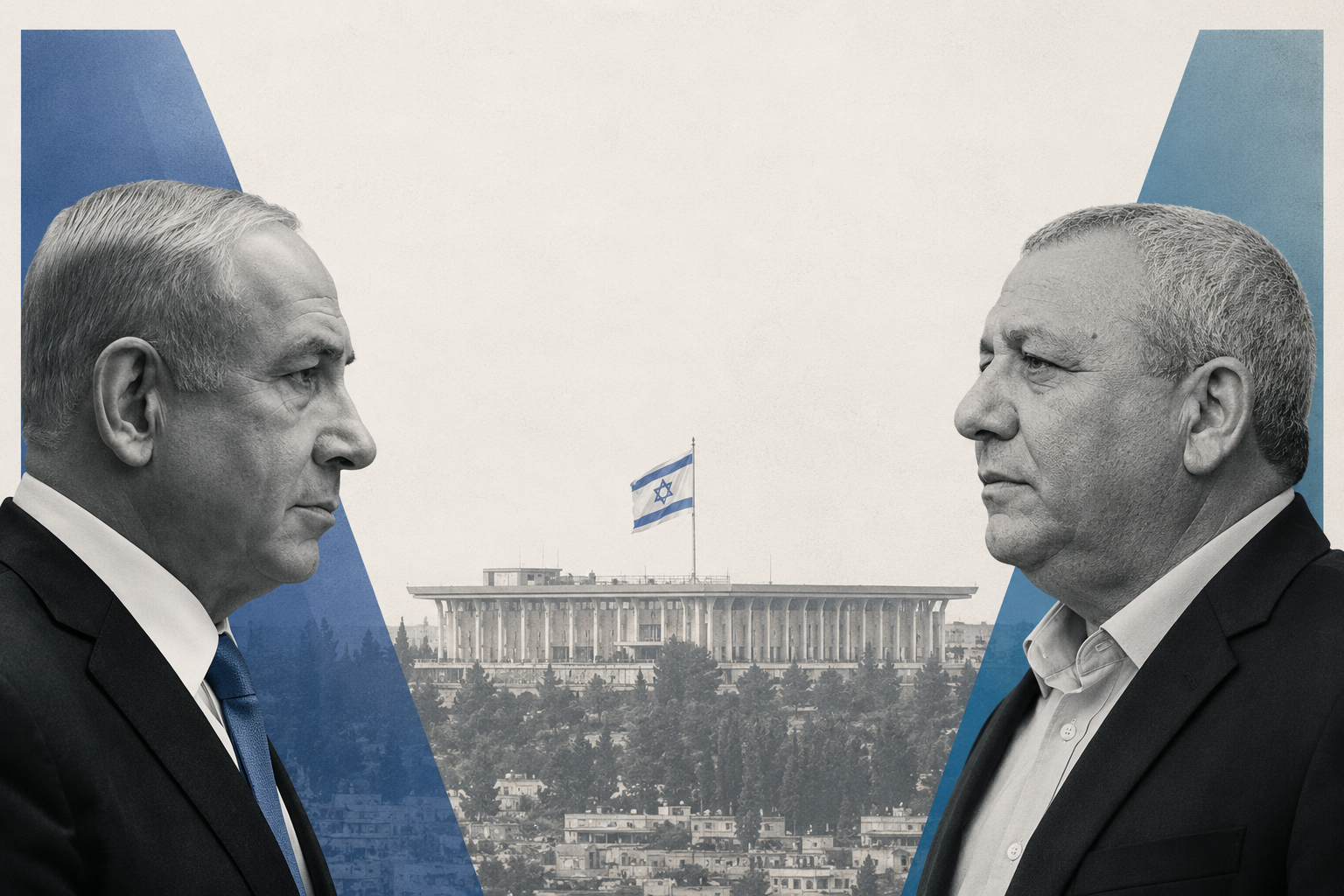
Israel’s October election is not simply another contest between Benjamin Netanyahu and a centrist challenger. It is increasingly a struggle over the political model that will govern the country after years of war: coalition survival or institutional reconstruction, selective privilege or universal service, personalised leadership or the return of the security-technocratic state.
Israel will vote on 27 October 2026 in its first parliamentary election since the Hamas attack of 7 October 2023 and the subsequent wars involving Gaza, Lebanon and Iran. The formal mechanics remain familiar: 120 seats elected through national proportional representation, a 3.25 per cent electoral threshold and the requirement that somebody eventually assemble a parliamentary majority. Yet the political environment in which Israelis are voting bears little resemblance to that of November 2022. The electorate has passed through the greatest security failure in the country’s history, prolonged mobilisation, deep internal disputes over military service, an unfinished constitutional confrontation over the judiciary and wars that have substantially altered Israel’s regional position.
Benjamin Netanyahu remains at the centre of this system. But for the first time in years, the principal threat to his continued dominance may come not from the traditional Israeli left but from within the country’s own security establishment. Former IDF Chief of Staff Gadi Eisenkot and his new Yashar party have risen rapidly enough for several August polls to place them either level with or ahead of Likud. One Channel 12 survey gave Yashar 24 seats against Likud’s 22, while another survey put Likud narrowly ahead, illustrating how fluid the race remains. More importantly, Reuters reported in mid-August that roughly a fifth of voters were still undecided and that many of them were former Likud voters, precisely the electorate both Eisenkot and former prime minister Naftali Bennett are attempting to capture.
The election should therefore not be understood primarily as a revival of Israel’s old left–right divide. The more significant contest is emerging inside the broad Israeli security consensus, between competing conceptions of state, authority, sacrifice and governance.
The old left-right map no longer explains Israeli politics
For decades, the most obvious dividing line in Israeli politics concerned territory and the Palestinians: Oslo, settlements, withdrawal and the possibility of a Palestinian state. That cleavage has not disappeared, but after 7 October it no longer structures the political centre in the same way.
Eisenkot is the clearest evidence of this transformation. International reporting frequently describes him as a centrist or moderate, yet these labels can be misleading outside the Israeli context. He has deliberately avoided adopting the traditional formula of “two states for two peoples,” arguing that the conflict is deeper than advocates of an immediate two-state settlement acknowledge. He has also said that he could support West Bank settlement where it conforms to what he regards as Israel’s strategic interests.
That is not the programme of a revived Israeli peace camp. Nor is Eisenkot militarily dovish. His career is associated with strong deterrence, the campaign against Iranian military entrenchment in Syria and the strategic logic commonly linked to the Dahiya doctrine. As a member of the emergency government after 7 October, he participated directly in the first phase of Israeli wartime decision-making. His subsequent break with Netanyahu concerned the conduct and political management of the war, including objectives, hostages, the possibility of opening an immediate second major front against Hezbollah and the absence of a clearly defined post-war strategy, rather than opposition to the use of military force itself.
The significance of his rise is therefore that Israelis dissatisfied with Netanyahu no longer have to choose between security and political change. Eisenkot is trying to remove that choice altogether. This helps explain why the decisive constituency may be the so-called soft right: voters who remain security-minded, sceptical of rapid territorial compromise and culturally distant from the historic left, but who have become uncomfortable with Netanyahu’s dependence on ultra-Orthodox and religious-nationalist parties, his confrontation with state institutions or his handling of the failures surrounding 7 October.
The New Yorker captured this distinction well in describing Eisenkot as potentially Netanyahu’s strongest challenger precisely because his Moroccan background, Golani identity and security biography allow him to compete in constituencies where previous centre-left challengers struggled.
The political battle is thus moving away from a simple question of right versus left toward a less familiar choice between different versions of the Israeli right and centre.
Netanyahu’s coalition model is beginning to expose its contradictions
Netanyahu’s resilience has never depended solely on Likud’s size. His political achievement has been the construction of durable parliamentary alliances among groups with substantially different interests: Likud voters, ultra-Orthodox parties, religious Zionists and the nationalist right.
That architecture gave Netanyahu his governing majority after the 2022 election. It has also created one of the central contradictions of Israeli politics after several years of war. Religious Zionist communities contribute disproportionately to combat formations and have suffered significant casualties. Ultra-Orthodox parties, by contrast, have fought to preserve broad exemptions from military service for yeshiva students. The contradiction became increasingly difficult to sustain after the Supreme Court ruled in 2024 that the existing exemption arrangements lacked a lawful basis and the IDF simultaneously faced severe manpower pressure.
The consequences are now political. Finance Minister Bezalel Smotrich, whose constituency contains many soldiers and reservists, has faced criticism from his own supporters for accommodating legislation designed to protect ultra-Orthodox draft evaders from arrest. Reuters reported that some former Religious Zionism voters now argue that the state simply cannot maintain an army if such inequalities continue indefinitely.
This is much more than another coalition dispute. Military service has become a question about the social contract of the Israeli state.
Who fights? Who carries the economic burden created by repeated reserve mobilisation? Who receives exemptions? And can political parties whose voters are largely excluded from those burdens nevertheless determine defence policy and the composition of governments? These questions create an unusually favourable terrain for Eisenkot.
“Service for All” is becoming a political doctrine
Eisenkot has made universal service one of Yashar’s defining policies. His proposal would require military, national or civil service across Israeli society, including the ultra-Orthodox community, with only a narrow category of exceptional exemptions. In August he said that approximately three per cent of each cohort could receive exceptional status for excellence in areas such as Torah scholarship, science, music or sport, and declared that the principle was sufficiently important that he would prefer another election to abandoning it.
The proposal has tactical as well as ideological value. It allows Eisenkot to speak simultaneously to reservists, secular centrists, religious Zionists and parts of the traditional Likud electorate. His own family history gives the issue exceptional resonance: his son Gal was killed fighting in Gaza in December 2023, and two nephews were later killed in combat. This does not automatically determine his politics, but it makes it considerably more difficult for opponents to portray universal service simply as an anti-religious demand. The argument becomes instead one of reciprocity between citizenship and sacrifice.
There is also a deeper historical dimension. Conflict over religious exemptions and national service has existed since the foundation of Israel and was closely connected to David Ben-Gurion’s concept of mamlachtiyut, the idea of the state as an institution capable of transcending narrower communal loyalties. The current dispute is therefore an old Israeli argument reactivated under the extreme conditions created by prolonged mobilisation. (Bick, 2013).
This helps explain why Eisenkot’s emphasis on mamlachtiut is politically significant. He is trying to transform what can sound like an abstract concept of “statesmanship” into a concrete proposition: the state must demand obligations from citizens more evenly because the state itself must stand above sectoral bargains.
That principle directly challenges the coalition logic on which Netanyahu has relied.
The judiciary remains the second unresolved fault line
The war interrupted but did not eliminate Israel’s constitutional crisis. Before 7 October 2023, Netanyahu’s government had been consumed by mass protests against a proposed judicial overhaul designed to reduce the authority of the Supreme Court and increase political control over key institutional mechanisms. Academic analysis at the time described the project as a form of populist constitutionalism particularly consequential in Israel because the country possesses few institutional checks on executive-coalition power. (Roznai and Cohen, 2023).
The confrontation has returned. In July 2026, Justice Minister Yariv Levin and Communications Minister Shlomo Karhi publicly challenged a Supreme Court ruling concerning regulation of Israeli broadcasting and said it would not be respected, reviving concerns over the balance between elected government and judicial authority.
This gives the October election a constitutional dimension that exists alongside the security debate. Netanyahu’s supporters continue to argue that courts and unelected legal institutions accumulated excessive power and must be restrained by elected governments. His opponents increasingly interpret the same struggle as evidence that Netanyahu’s coalition seeks to subordinate professional and judicial institutions to political control.
Eisenkot’s answer is not an elaborate liberal constitutional theory. It is again mamlachtiut: investigation, institutional responsibility and restoration of public trust. At his campaign launch he promised immediately to establish a state commission of inquiry into the failures surrounding 7 October and framed Yashar’s programme around institutional repair, rehabilitation of the country’s damaged north and south, and redistribution of the military burden.
The contrast is therefore becoming structurally clear. Netanyahu argues principally from electoral mandate and political authority. Eisenkot argues from institutional competence and state responsibility.
The return of the generals
The phenomenon itself is deeply Israeli. Former generals have entered Israeli politics since the earliest years of the state. Moshe Dayan, Yitzhak Rabin, Ariel Sharon, Ehud Barak and Benny Gantz all moved from senior military positions into national political leadership.
Yet the present conflict has a particular character. Political scientist Yagil Levy has argued that Israel simultaneously possesses strong civilian control of the IDF and a deeply militarised political culture in which security reasoning retains exceptional legitimacy. Yoram Peri has similarly analysed the persistent tension between Netanyahu and senior members of the security establishment, describing disagreements over Iran, the Palestinians, the judiciary and the broader relationship between professional security institutions and political leadership.
Eisenkot’s rise fits this pattern, but with an important qualification. He is not an outsider challenging “the system.” He represents a substantial part of the system itself. His political world originates in the IDF General Staff, institutional national-security culture and the tradition that sees professional state bodies as sources of expertise and continuity. His current campaign network likewise contains former military and security officials. The confrontation with Netanyahu is therefore best understood as an intra-establishment conflict between two different forms of authority.
Netanyahu’s model has become increasingly personalised: leadership is organised around the prime minister’s political survival, his relationship with Likud voters and his ability to maintain coalitions with sectoral parties. Eisenkot represents a security-technocratic alternative that places greater emphasis on professional institutions, collective obligation and administrative competence.
Neither model is anti-system. They are rival visions of the Israeli system.
But Eisenkot has a coalition problem
Winning the largest number of seats does not make somebody prime minister in Israel. This may become the decisive weakness of the anti-Netanyahu camp.
Even if Yashar finishes ahead of Likud, Eisenkot must still construct a coalition capable of reaching 61 seats. The opposition to Netanyahu remains fragmented among Eisenkot, Naftali Bennett, Yair Lapid, Avigdor Liberman, the Democrats and Arab political parties. Reuters therefore cautions that despite polling suggesting Netanyahu could lose, no rival possesses an obvious route to power.
Bennett presents a particularly important complication because he and Eisenkot are competing for many of the same soft-right voters. Bennett can argue that he is more clearly rooted in the ideological right; Eisenkot counters with greater military authority and a more explicitly statist political identity. Their competition may strengthen the broader anti-Netanyahu vote while simultaneously making coalition leadership more difficult. As the campaign enters its final phase, the question of which man can claim leadership of the post-Netanyahu centre-right may become nearly as important as their competition with Likud.
Then there is the Arab-party question. Netanyahu’s campaign has repeatedly used the possibility that his opponents might require Arab parliamentary support as a means of delegitimising alternative coalitions. Eisenkot would prefer not to form a minority government dependent upon outside support, but has acknowledged that coalition arithmetic may ultimately become difficult enough to force uncomfortable choices.
This creates the central paradox of the election. Eisenkot may be capable of defeating Netanyahu politically while remaining incapable of replacing him mathematically. Netanyahu’s greatest asset is therefore still not necessarily popularity. It is coalition engineering.
A change of government would not mean a strategic revolution
International observers should also be careful not to interpret an Eisenkot victory as a restoration of the pre-2000 Israeli peace process. The Israeli political centre has moved substantially.
The fragile Gaza ceasefire established in October 2025 continues to be accompanied by Israeli military strikes and unresolved disputes over Hamas disarmament, Israeli withdrawal and the future political administration of Gaza. Meanwhile, settlement expansion and settler violence in the West Bank have generated renewed criticism from Western governments.
A government led by Eisenkot would probably alter Israel’s political style and perhaps its relations with Western partners more substantially than it would alter the foundations of Israeli security policy.
He is likely to place greater emphasis on coordination with the United States, professional military planning and defined political objectives. He would probably be less dependent upon figures such as Itamar Ben-Gvir and Bezalel Smotrich. A state commission investigating 7 October would fundamentally alter the politics of accountability.
But none of this automatically implies rapid Palestinian statehood, withdrawal from major settlement blocs or a less forceful approach toward Iran and armed non-state actors.
This distinction is important because it explains why financial markets are following the election so closely. JPMorgan recently estimated a 55 per cent probability of an opposition victory and argued that such an outcome might strengthen the shekel by two to three per cent, not because it expected a radically different economic programme but because investors could perceive reduced institutional risk surrounding the judiciary and Israel’s relations with Western allies. In other words, the market is pricing governance, not ideological transformation.
The real question after Netanyahu
The October election may therefore answer a question larger than who becomes Israel’s next prime minister. The political order created after 7 October is testing the sustainability of several bargains that have structured Israeli politics for decades: ultra-Orthodox exemptions from service, the relationship between elected politicians and the judiciary, the place of professional security institutions in political decision-making and the ability of a prime minister to maintain a coalition composed of sectors whose visions of the Israeli state increasingly diverge.
Netanyahu has survived repeated political crises because he mastered those contradictions rather than resolving them. Eisenkot’s political proposition is essentially the opposite. He argues that the contradictions themselves have become strategically dangerous and that Israel requires a restoration of collective obligation, institutional responsibility and state capacity.
That does not make him the representative of a new Israeli left. It makes his challenge more consequential.
The emerging alternative to Netanyahu is not pacifist, post-Zionist or anti-establishment. It is heavily rooted in the IDF, committed to military strength and cautious on the Palestinian question. What separates it from Netanyahu is primarily its conception of how the Israeli state should exercise power and how the burdens required to sustain that power should be distributed.
This is why the 2026 election increasingly looks less like another referendum on Benjamin Netanyahu personally and more like a contest between two models of Israel. One is built around a dominant political leader capable of holding together religious, nationalist and sectoral coalitions through extraordinary political skill. The other seeks to rebuild the authority of the professional state around security credibility, universal obligation and institutional repair.
Netanyahu remains the more experienced politician. Eisenkot increasingly represents the more dangerous opponent precisely because he is not asking Israeli voters to abandon the security politics that have defined the country since 7 October. He is asking them to entrust those politics to a different kind of state.
References
Akirav, Osnat. “Legislative–Executive Relations in Israel: Constitutional Crisis 2023–2024.” PS: Political Science & Politics 58, no. 1 (2025): 111–113.
Bick, Etta. “Equality, Orthodoxy and Politics: The Conflict over National Service in Israel.” Israel Affairs 19, no. 3 (2013): 505–525.
Knesset. “Elections for the Twenty-Sixth Knesset.” Jerusalem, 2026. The official election information confirms 27 October 2026 as election day and the 3.25 per cent electoral threshold.
Levy, Yagil. “Israel: A Politically Monitored Military in a Militarized Society.” Oxford Research Encyclopedia of Politics. Oxford University Press, 2020.
Peri, Yoram. Netanyahu vs The Generals: The Battle for Israel’s Future. Cambridge: Cambridge University Press, 2024.
Peri, Yoram. “The Military in Israeli Politics.” In The Oxford Handbook of Israeli Politics and Society, edited by Reuven Y. Hazan et al. Oxford: Oxford University Press, 2021.
Roznai, Yaniv, and Amichai Cohen. “Populist Constitutionalism and the Judicial Overhaul in Israel.” Israel Law Review 56 (2023): 502–520.
Remnick, David. “How Netanyahu’s Top General Became His Strongest Challenger.” The New Yorker, 3 August 2026 issue.
Reuters. “Israeli Elections: How They Work and Who Is in the Race.” 29 July 2026.
Reuters. “Political Struggle of Far-Right Ally Smotrich Shows Faultline in Netanyahu Coalition.” 7 August 2026.
Reuters. “Netanyahu’s Re-Election Hopes Ride on Divided Party’s Primaries.” 17 August 2026.
Reuters. “Israel Election Could Swing Shekel by Up to 3%, JPMorgan Estimates.” 27 August 2026.