
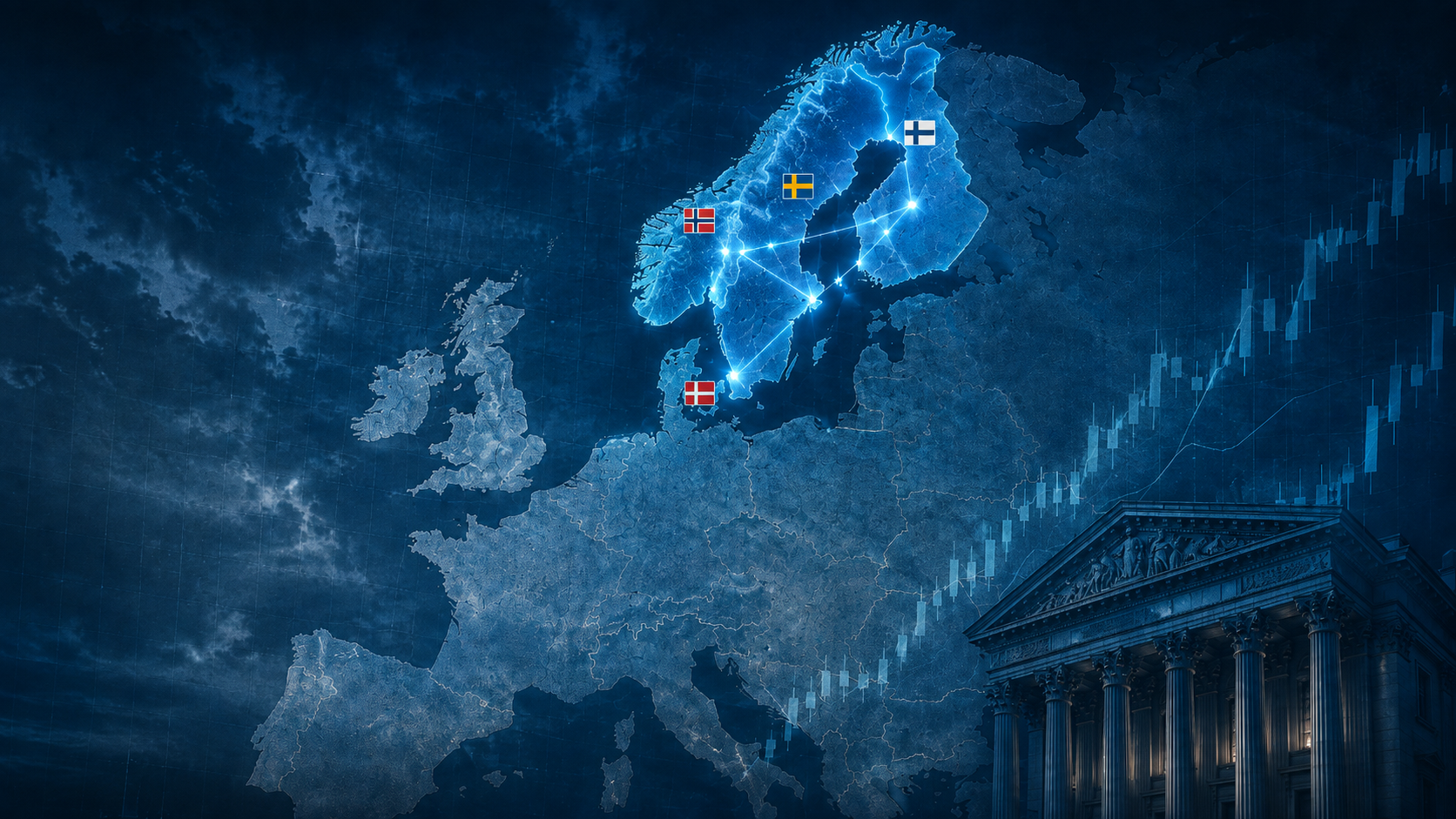
For most of their modern history, stock exchanges were treated as national institutions. Paris had its bourse, London its Exchange, Frankfurt its Börse, Athens its own market and the Nordic economies their respective trading centres. They were financial institutions, but they were also expressions of economic geography: markets organised around national currencies, domestic companies, local investors and national regulatory systems.
That model is increasingly difficult to sustain.
In August 2026, reports emerged that some of the largest companies, investors and financial institutions in the Nordic countries were examining the possibility of creating a unified regional stock exchange. The proposal is being discussed within Nordic Compass, a pan-Nordic initiative launched earlier in the year and backed by institutions including Wallenberg Investments, EQT, Nordea, SEB, the Novo Nordisk Foundation and Nasdaq. Among the options under consideration is the deeper integration of the capital markets of Sweden, Denmark, Norway and Finland, potentially extending as far as the consolidation of existing exchanges into a common Nordic market (Sjolin, Heikel and Lindeberg, 2026). No agreement has yet been reached, and the project remains exploratory. Yet its importance extends beyond Scandinavia.
The Nordic discussion reflects a much larger transformation in the architecture of global finance. Stock exchanges are no longer simply locations where securities are traded. They have become technological and institutional infrastructures connecting listing, trading, clearing, settlement, data and increasingly other financial services. In this environment, scale matters. Liquidity matters. Technology matters. And the ability to connect domestic savings with firms capable of growing internationally matters perhaps most of all. The consolidation of exchanges should therefore be understood not merely as another cycle of corporate mergers and acquisitions. It forms part of a broader struggle over how capital is organised, where liquidity is concentrated and which financial centres possess the infrastructure necessary to support economic power.
From National Institutions to Financial Networks
The economic logic behind exchange consolidation begins with a relatively simple observation: financial markets exhibit powerful network effects. A market becomes more attractive when more participants use it. More investors generate greater trading activity; greater trading activity tends to support liquidity; greater liquidity can reduce transaction costs and improve price discovery; and these advantages may in turn attract additional investors and issuers. This creates a self-reinforcing process.
Di Noia (2001) demonstrated that network externalities are central to understanding competition and integration among European exchanges. Under certain conditions, compatibility between exchanges, remote access and forms of what he described as “implicit mergers” can generate more efficient outcomes than isolated national competition. The implication is important. The economic value of an exchange does not derive only from the companies formally listed on it. It also depends on the depth of the network surrounding those companies: investors, brokers, market makers, clearing systems, settlement infrastructure, data providers and technology platforms.
This helps explain why technological integration frequently precedes institutional consolidation. The Nordic region itself provides an example. Nasdaq already operates the exchanges of Sweden, Denmark, Finland and Iceland through common technological infrastructure and provides investors with a common gateway for Nordic equities. Common trading rules and shared systems have substantially reduced the meaning of national technological borders even while separate legal exchanges remain in existence.
The Nordic debate of 2026 therefore represents something more sophisticated than simply merging several organisations. Much of the technical integration has already occurred. The question is whether regulatory, institutional and ownership structures should now move closer to the financial reality that technology has already created.
The Economics of Scale
Exchange consolidation is also driven by economies of scale. Modern financial markets require expensive technological infrastructure. Trading engines must process enormous numbers of orders with extremely low latency. Surveillance systems must detect manipulation. Cybersecurity systems must protect critical infrastructure. Clearing and settlement mechanisms must operate reliably across jurisdictions and currencies. Once these systems have been developed, however, the marginal cost of adding additional securities or additional transactions can be relatively limited.
Research on securities infrastructure has found significant economies of scale, particularly in clearing, depository and settlement systems (Schmiedel, Malkamäki and Tarkka, 2006). This is particularly relevant in Europe, where cross-border settlement has historically been more complicated and costly than domestic settlement because of differences in national legal structures, taxation, market practices and infrastructure. Exchange consolidation therefore promises something that national fragmentation struggles to provide: the possibility of spreading large fixed technological and regulatory costs across a much larger volume of transactions. Yet the argument is not solely about lowering costs.
Hasan and Schmiedel (2004), examining European exchanges, found that network cooperation was associated with greater market capitalisation, stronger growth and, to some extent, lower transaction costs. More recent research has also suggested that common exchange platforms can facilitate cross-border portfolio investment. Giofré (2021), using data covering 40 investing countries and 41 destination markets, found that exchange consolidation increased cross-border equity holdings, with particularly significant effects among countries that were smaller and economically and geographically close. That finding is highly relevant to the Nordic case. Sweden, Denmark, Norway and Finland are individually prosperous and financially sophisticated economies. Together, however, they constitute a considerably more substantial investment universe. From the perspective of an international institutional investor in New York, London, Singapore or the Gulf, the relevant economic unit may increasingly be “the Nordics” rather than four separate national markets. The institutional architecture of the region has not yet fully caught up with that perception.
Euronext and Europe’s First Great Experiment
Europe has already conducted an extensive experiment in exchange consolidation. Euronext was created in 2000 through the merger of the Amsterdam, Brussels and Paris exchanges. Lisbon joined in 2002. The group later expanded through a series of acquisitions that brought Dublin, Oslo and Milan into the same wider infrastructure. The strategic importance of Euronext was that it demonstrated that historically national exchanges could retain local identities while sharing technology, market infrastructure and eventually elements of a common liquidity architecture.
The results, however, also reveal why consolidation should not be romanticised. Nielsson’s (2009) study of the Euronext merger found that the benefits to liquidity were unevenly distributed. Larger firms and companies with substantial foreign sales experienced significant improvements, whereas smaller and more domestically oriented firms did not benefit to the same extent. This distinction matters because exchange consolidation is often presented as though greater scale automatically improves financing conditions for every listed company. The empirical evidence is more complicated. Liquidity gravitates toward securities that already possess characteristics attractive to international capital. Consolidation can enlarge the pool of investors capable of reaching those securities, but it does not automatically transform every small domestic company into an internationally liquid asset.
Similar caution emerges from research elsewhere. Teplova and Rodina (2016), studying the consolidation of Russian exchanges, found that the effects on liquidity were not uniformly positive. Large-capitalisation companies benefited more clearly than the broader market. Scale can improve market infrastructure. It cannot abolish the underlying economics of investor attention.
The Nordic Paradox: Abundant Capital, Incomplete Integration
The Nordic proposal is especially striking because the region does not suffer from a shortage of financial wealth. According to figures cited by Nordic Compass, Nordic pension funds and sovereign investors collectively manage close to $4 trillion in assets and receive annual inflows exceeding $175 billion. Nevertheless, the region has struggled to channel sufficient quantities of this capital toward companies as they move from start-up to scale-up and eventually toward public markets. Some of the Nordic region’s most successful growth companies have consequently looked to the United States for capital, listings or both.
The problem is therefore not simply one of savings. It is an intermediation problem. Europe possesses large pools of private wealth, sophisticated companies and significant household savings, yet it remains less effective than the United States at converting these resources into deep, integrated capital markets.
The European Commission’s Savings and Investments Union strategy acknowledged this structural weakness in 2025. Around 70 per cent of EU household savings, representing approximately €10 trillion, remained in bank deposits rather than being channelled more directly into capital-market instruments. At the same time, European equity markets remained considerably smaller relative to the economy than those of the United States (European Commission, 2025).
The European Central Bank has similarly emphasised that financial assets in Europe continue to be issued, held, traded and settled to a considerable degree within national institutional structures. Differences in securities law, taxation, settlement practices and supervision continue to obstruct the emergence of a genuinely integrated European financial market (ECB, 2026). This is precisely the structural problem identified in Mario Draghi’s 2024 report on European competitiveness. Europe does not lack capital in absolute terms. It lacks sufficient mechanisms for mobilising that capital at continental scale. Exchange consolidation is one part of that problem.
Integration Does Not Mean a Single Monopoly
There is nevertheless an important conceptual distinction between integrating markets and eliminating competition. Financial economics has long recognised the tension between consolidation and fragmentation. Network effects favour concentration because investors prefer markets where other investors are already present. Yet competition between trading venues can also reduce fees, stimulate technological innovation and produce services tailored to different types of investors. Gomber et al. (2017) therefore describe the structure of equity markets as a balance between the benefits of consolidation and the benefits of competing venues. A completely fragmented system can disperse liquidity and complicate execution. A completely monopolised system can create excessive market power and reduce competitive discipline.
European regulators have confronted this dilemma directly. The proposed merger between Deutsche Börse and London Stock Exchange Group would have created one of the world’s largest market-infrastructure companies. The European Commission prohibited the transaction in 2017, concluding that it would have created a de facto monopoly in important areas of fixed-income clearing.
That episode illustrates a central paradox. Europe wants larger financial-market institutions capable of competing globally, but the creation of those institutions can itself generate concerns over competition and systemic concentration. The central policy challenge is therefore not consolidation at any cost. It is to determine which forms of consolidation increase market depth and efficiency without creating excessive dependence on a small number of infrastructure providers.
Athens and the Geography of European Capital
The issue has particular relevance for Southeast Europe. In November 2025, Euronext acquired a majority stake in the Athens Stock Exchange. In April 2026, the exchange was rebranded as Euronext Athens, marking another stage in its planned integration into Euronext’s wider pan-European infrastructure.
For Greece, this development raises precisely the questions already visible in the Nordic debate. The immediate interpretation of such transactions often focuses on ownership: a national stock exchange has been acquired by a larger foreign group. But ownership alone is not the most important issue.
The more consequential question concerns connectivity. Can a relatively small national market gain deeper access to international investors? Can domestic companies become visible to a broader pool of institutional capital? Can common technology and settlement infrastructure reduce the frictions that discourage international participation? And can such integration expand the ability of domestic firms to finance growth without abandoning their home region for London or New York? Giofré’s (2021) findings are especially relevant here because the positive effects of common exchange platforms on cross-border investment appear particularly strong for smaller participating economies.
For smaller European markets, therefore, consolidation may not primarily represent the loss of financial sovereignty. Under the right institutional conditions, it may instead represent a mechanism for exercising economic relevance at a scale that national markets alone cannot achieve. There is nevertheless a trade-off. As exchanges become parts of larger transnational networks, decisions concerning technology, market structure, investment priorities and infrastructure increasingly migrate from national institutions toward regional or global operators. The future European financial system may therefore become simultaneously more integrated and less national.
Financial Infrastructure as Strategic Infrastructure
The political significance of stock exchanges is easy to underestimate because their operations appear technical. Yet market infrastructure determines how capital moves. It determines where companies list, where investors concentrate liquidity, how securities are settled, what data markets generate and which institutions occupy central positions in the financial system.
In the nineteenth and twentieth centuries, governments frequently treated railways, ports and energy systems as strategic infrastructures because they connected national economies and shaped the movement of goods. In the twenty-first century, capital-market infrastructure increasingly performs an analogous function for finance.
The consolidation of exchanges should therefore be understood within the broader debate over European competitiveness and strategic autonomy. A continent that produces innovative companies but cannot finance their expansion risks seeing those companies migrate toward deeper foreign capital markets. A region with substantial savings but fragmented investment channels may export its capital while importing financial infrastructure. And an economy that relies overwhelmingly on bank financing may struggle to provide sufficient risk capital for young, technology-intensive firms. The objective of capital-market integration is consequently not to create larger exchanges for their own sake. It is to shorten the institutional distance between European savings and European investment.
Conclusion
The proposed Nordic exchange is still only a proposal. Nordic Compass has indicated that its work remains exploratory, and significant institutional obstacles stand between today’s fragmented ownership structure and any truly unified regional market.
Yet the debate itself is revealing. The economic logic of national stock exchanges is becoming progressively weaker in a financial system dominated by electronic trading, international institutional investors and enormous fixed costs in technology and market infrastructure.
Research suggests that consolidation can generate economies of scale, facilitate cross-border investment and improve liquidity. But the benefits are neither automatic nor equally distributed. Larger and more internationally oriented firms tend to gain more, while excessive concentration can create competition and systemic-risk concerns.
The real question facing Europe is therefore not whether every national exchange should disappear. It is whether Europe can construct capital-market institutions large enough to mobilise its savings, finance its companies and compete with deeper global markets while still preserving competition, regulatory accountability and access for smaller firms.
The Nordic proposal, the expansion of Euronext and the integration of Athens are different manifestations of the same structural transformation. Europe’s financial map is being redrawn. The borders that matter increasingly are not those surrounding the old national trading floors, but those determining where liquidity, technology and capital can move freely. And in modern financial systems, whoever builds those connections does more than operate a market. They help determine where economic power accumulates.
References
Di Noia, C. (2001). Competition and integration among stock exchanges in Europe: Network effects, implicit mergers and remote access. European Financial Management, 7(1), 39–72. doi:10.1111/1468-036X.00144.
Draghi, M. (2024). The Future of European Competitiveness: A Competitiveness Strategy for Europe. European Commission.
European Central Bank. (2026). Financial Integration and Structure in the Euro Area. European Central Bank.
European Commission. (2017). Case M.7995 — Deutsche Börse/London Stock Exchange Group: Commission Decision of 29 March 2017.
European Commission. (2025). Savings and Investments Union: A Strategy to Foster Citizens’ Wealth and Economic Competitiveness in the EU. COM (2025) 124 final.
Giofré, M. (2021). Stock exchange consolidation and cross-border investment: An empirical assessment. Journal of Financial Stability, 53, 100796. https://doi:10.1016/j.jfs.2020.100796.
Gomber, P., Sagade, S., Theissen, E., Weber, M. C., & Westheide, C. (2017). Competition between equity markets: A review of the consolidation versus fragmentation debate. Journal of Economic Surveys, 31(3), 792–814. doi:10.1111/joes.12176.
Hasan, I., & Schmiedel, H. (2004). Networks and equity market integration: European evidence. International Review of Financial Analysis, 13(5), 601–619. https://doi:10.1016/j.irfa.2004.02.015.
Nielsson, U. (2009). Stock exchange merger and liquidity: The case of Euronext. Journal of Financial Markets, 12(2), 229–267. https://doi:10.1016/j.finmar.2008.07.002.
Nasdaq. (2026a). Nordic Compass: Nasdaq Joins Major New Collaboration With Nordic Businesses. Nasdaq Newsroom.
Nasdaq. (2026b). How Nasdaq Nordic Markets Led Europe’s Listing Landscape in the First Half of 2026. Nasdaq Newsroom.
Schmiedel, H., Malkamäki, M., & Tarkka, J. (2006). Economies of scale and technological development in securities depository and settlement systems. Journal of Banking & Finance, 30(6), 1783–1806. https://doi:10.1016/j.jbankfin.2005.09.003.
Sjolin, S., Heikel, K., & Lindeberg, R. (2026, August 26). Nordic Alliance Said to Explore Region-Wide Stock Exchange. Bloomberg.
Teplova, T. V., & Rodina, V. A. (2016). Does stock exchange consolidation improve market liquidity? A study of stock exchange acquisition in Russia. Research in International Business and Finance, 37, 375–390. https://doi:10.1016/j.ribaf.2016.01.016.