
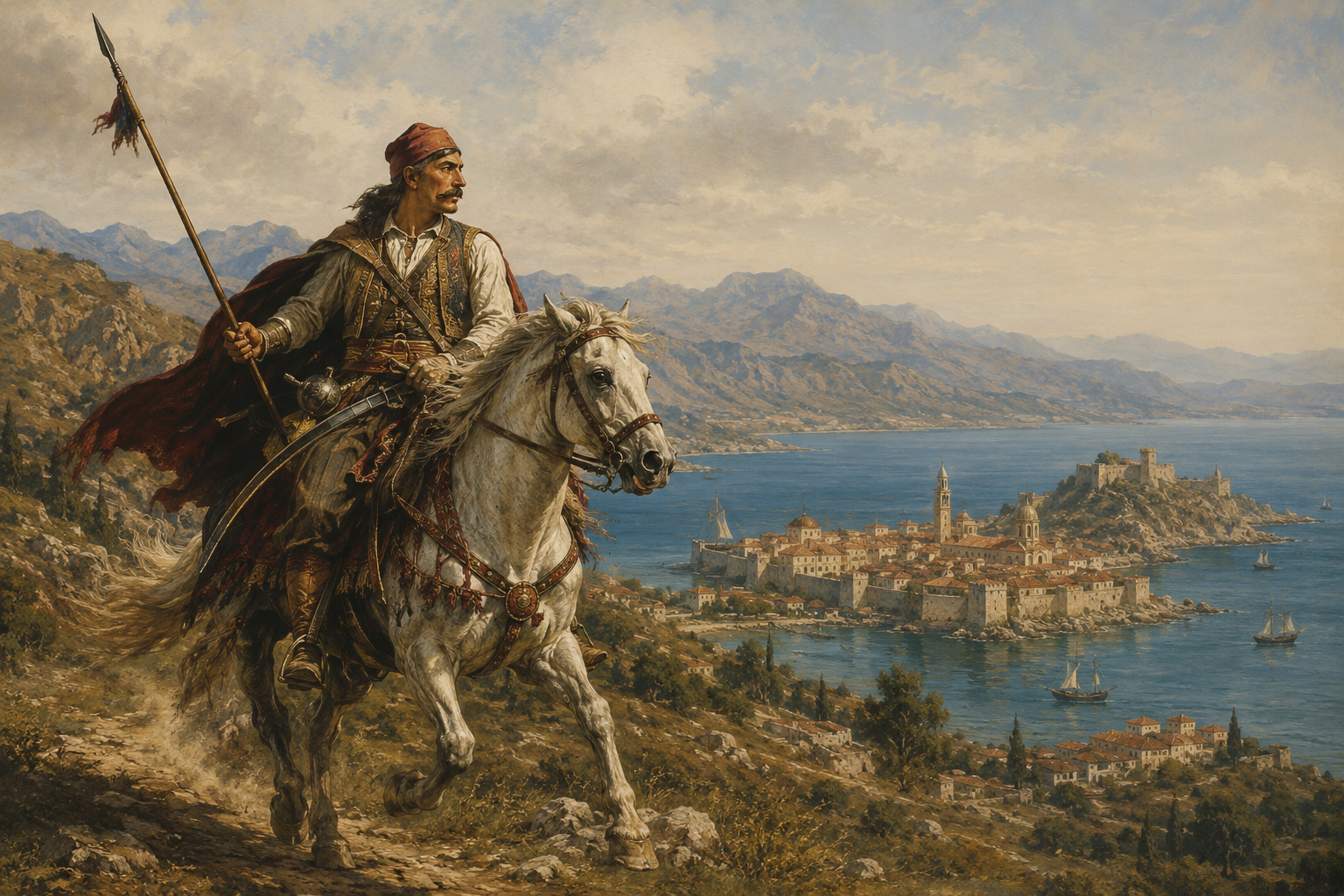
For more than two thousand years, the Greek word στρατιώτης – stratiōtēs, has meant a soldier. Yet during the final centuries of Byzantium and the expansion of Venetian power into the eastern Mediterranean, the same word began to acquire a more specific meaning. In Italian and Western European sources, the stratiōtēs gradually became the stradiotto or stradiot: no longer simply a soldier, but a mounted warrior associated with the military frontier of the Greek lands, the western Balkans, including regions then described by names such as Arbanon and the Adriatic.
The transformation of the term reflects something larger than a linguistic change. It reveals the movement of military populations across the Balkans, the weakening of Byzantine authority, the expansion of Venice, the pressure of Ottoman conquest and the emergence of a mobile military diaspora that eventually carried Balkan cavalry traditions into the armies of Renaissance Europe.
The history of the stradioti is therefore not simply the history of a mercenary force. It is the history of how a word travelled between empires, and changed meaning as the political world around it changed.
The Original Meaning of Stratiōtēs
The Greek στρατιώτης was already an established military term in classical antiquity. Its basic meaning was straightforward: a man performing military service, or more generally a soldier. The term belongs to the linguistic family associated with στρατός (stratos), meaning an army or military host. Ancient lexicographical evidence gives stratiōtēs the sense of a citizen bound to military service and, more generally, a soldier.
There was originally nothing specifically Balkan, Arbanite, Venetian or even cavalry-related about the word. A stratiōtēs was simply a soldier.
This distinction becomes important because the later Western European word stradiot eventually acquired a much narrower meaning. Understanding that transformation requires looking first at the Byzantine military system in which the ancient Greek term survived.
The Byzantine Soldier and the Military Household
Throughout the Byzantine period, stratiōtēs continued to function as the ordinary Greek term for a soldier. Yet Byzantine administration also created institutional settings in which military service became associated with family resources, property and fiscal obligations. Older historical interpretations frequently described this system through the image of the Byzantine soldier-farmer. According to this model, provincial soldiers received or possessed plots of land in return for military service. The arrangement was often presented as one of the foundations of the Byzantine thematic armies: small landholders supported themselves economically and, when required, served the emperor as soldiers.
The reality appears to have been considerably more complex. Recent research by Salvatore Cosentino on the Byzantine oikoi stratiōtikoi, or “military households”, suggests that military obligation was not simply attached to an individual peasant cultivating a fixed military estate.
The oikos was central.
In Byzantine usage, an oikos could encompass a household, family and patrimony. During the tenth century, households subject to military obligations were entered into military registers, while legislation attempted to ensure that sufficient economic resources remained available for the fulfilment of military service (Cosentino, 2023). This created a system in which military obligation possessed both a personal and a patrimonial dimension. The man appearing for service mattered, but so did the household capable of sustaining him.
The distinction may appear technical, yet it changes the historical picture considerably. The Byzantine stratiōtēs should not be imagined as belonging to one rigid and unchanging social class. Military organisation evolved continuously. Provincial recruitment, taxation, imperial regiments, aristocratic military households, mercenaries and foreign troops all played different roles at different periods of Byzantine history.
What remained stable was the vocabulary. The word stratiōtēs survived even when the institutions surrounding the soldier changed.
A Note on Medieval Names: Arbanon, Arbanitai and Arvanites
Before discussing the population movements of the fourteenth and fifteenth centuries, the terminology requires care. The modern Albanian nation-state did not exist, and the political and national identities of the nineteenth and twentieth centuries should not be projected backwards onto the late medieval Balkans.
Medieval sources, however, were not without names for the populations in question. Greek, Latin, Slavic and Italian texts used forms such as Arbanitai, Albanoi, Arbanenses, Albanenses, Arbanasi and Albanesi. These terms were historically connected with the region of Arbanon/Arbanum and gradually acquired wider ethnographic and geographical uses (Komatina, 2021).
In the Greek lands, Arbanon related settlers and their descendants are commonly described in Greek historiography as Arvanites. This term is particularly useful when discussing the communities established in central and southern Greece, but it should not be treated as a universal medieval label for every population originating in territories that later became part of the modern Albanian state.
The labels Geg and Tosk require a different caution. They refer primarily to the two major dialectal groupings of Albanian. The division is old and predates the late-medieval diasporas that produced Arvanitika and Arbëresh, but Geg and Tosk should not automatically be converted into fixed political or national identities for every fourteenth- or fifteenth-century individual (Friedman & Joseph, 2025). Arvanitika itself belongs to the Tosk branch. For that reason, this article prefers Arbanite/Arvanite, or the terminology of a specific contemporary source whenever possible.
The Balkans After Byzantium
By the fourteenth and fifteenth centuries, the political environment of South-Eastern Europe had been transformed.
The Byzantine Empire had lost most of the territorial power it once possessed. Serbian principalities and other regional lordships, including polities in the western Balkans and in territories later incorporated into the modern Albanian state, competed for territory, while Venice controlled strategic ports and islands across the Adriatic and eastern Mediterranean. At the same time, Ottoman expansion increasingly reshaped the military geography of the region. The Balkans became a frontier of almost continuous political instability.
War generated movement. Communities migrated. Soldiers changed employers. Local rulers settled armed populations in strategically important regions. Families crossed boundaries that were far less fixed than the borders of modern states.
One of the most important movements involved populations, described in different sources by ethnonyms such as Arbanitai, Arbanenses or Albanenses, moving southward into Epirus, Thessaly and the regions of central and southern Greece, particularly during the fourteenth and fifteenth centuries. In the Greek lands, many of these settlers and their descendants belong to the historical population usually described as Arvanite. Some were pastoral communities. Others became agricultural settlers or military retainers. Byzantine and regional rulers could encourage their settlement in areas where population decline and political insecurity had created a need for both cultivators and armed manpower.
The Peloponnese became especially important, and late-medieval sources distinguish communities there through linguistic, fiscal, regional and military categories rather than through modern nationality alone (Giakoumis, 2003; Korrè, 2018; 2024).
Katerina Korrè has examined the relationship between these military settlements and earlier Byzantine institutional practices, particularly the use of land, privileges and fiscal arrangements to sustain populations capable of providing mounted military service (Korrè, 2018; 2024).
There are visible similarities with Byzantine precedents. But similarity does not necessarily mean direct institutional survival. Venice was an intensely pragmatic power. Where existing local arrangements could provide soldiers, tax revenue or political stability, Venetian administrators often adapted them rather than replacing them completely. The stradioti emerged from this hybrid environment.
Venice Turns a Soldier into a Military Category
By the second half of the fifteenth century, Venice was systematically recruiting mounted troops from the Morea, the Greek lands, its possessions and zones of influence in the western Balkans, and the Adriatic.
Western documents increasingly referred to them as stradioti, stradiotti, or related forms. The linguistic origin is significant. The Italian stradiotto derives from the Greek stratiōtēs. Treccani explicitly identifies the Greek origin of the term and, using conventional modern historiographical categories, describes the stradioti as members of a light cavalry force organised by Venice during the second half of the fifteenth century, composed of Greeks and Dalmatians.
Something important had therefore happened to the word. In Greek, stratiōtēs could still mean any soldier. In Venetian Italian, stradiotto increasingly meant a particular kind of soldier. The term was becoming a military category. A generic Greek military word had acquired a geographical and tactical identity.
The transformation can be represented simply:
στρατός — stratos (army)
στρατιώτης — stratiōtēs (soldier)
stradiotto / stradiot (Balkan light cavalryman in Western military usage)
What Made the Stradioti Different?
The stradioti were primarily mounted soldiers whose value derived from mobility. They were not simply lighter versions of the heavily armoured knights and men-at-arms that dominated the traditional image of Western European cavalry. Their military culture had developed in a different strategic environment.
The Balkan frontier demanded reconnaissance, raiding, rapid movement, ambush, pursuit and the ability to operate across difficult terrain with relatively limited logistical support. Stathis Birtachas describes the Venetian stradioti as mercenary light cavalry of Greek, Albanian and Slav origin whose systematic recruitment began during the second half of the fifteenth century (Birtachas, 2018).
Their weapons and equipment varied. There was no perfectly standardised stradiot uniform, and surviving descriptions should not be interpreted as evidence of an entirely homogeneous military force. Their battlefield function, however, was sufficiently distinctive to attract considerable attention in Italy. They could scout ahead of an army, harass enemy formations, strike vulnerable positions, raid territory, pursue withdrawing troops and disrupt communications. Their style of warfare had been shaped by the military environment of South-Eastern Europe. It was also a frontier environment in which Christian Balkan forces and Ottoman troops had observed, fought and adapted to one another over generations. The stradioti therefore should not be understood as an isolated military invention. They belonged to a broader system of mobile warfare that had developed across the Byzantine, Balkan and Ottoman frontier.
From the Morea to Renaissance Italy
Venice gave the stradioti something previous Balkan employers could not provide on the same scale: access to a trans-Mediterranean military system. The Republic controlled territories stretching from northern Italy through the Adriatic and into the eastern Mediterranean. Soldiers recruited in the Peloponnese or the Adriatic could therefore be transferred westward and deployed in conflicts far from their places of origin. The Italian wars provided precisely such an opportunity.
Once Balkan cavalry began operating in Italy, their reputation expanded beyond Venice. Western military elites encountered soldiers whose methods reflected a frontier culture different from the conventional heavy cavalry traditions of Western Europe. The stradioti increasingly became part of a larger European market for military labour.
Nicholas C. J. Pappas has described this process as the formation of a Balkan military diaspora. Within several decades of their deployment in Italy, stradioti could be found serving not only Venice but also France, England, Spain and the Habsburg monarchy (Pappas, 2022). Their movement across Europe also completed the linguistic journey of their name.
The Italian stradiotto entered other European languages. French sources used forms such as stradiot and estradiot, where the term referred specifically to a light cavalryman associated with the Greek lands or with western Balkan regions that Western sources often grouped under names such as Albania. The Greek word for an ordinary soldier had become an internationally recognisable military label.
How Should We Describe the Stradioti?
The familiar modern question, “were the stradioti Greek or Albanian?”, is itself partly anachronistic. It assumes that the political nationalities of the modern Balkans can be transferred unchanged to a fifteenth-century military population.
The word itself is unquestionably Greek in origin. Greek-speaking soldiers formed part of the stradiot world, Greek territories were central to recruitment, and aspects of their organisation developed within regions shaped for centuries by Byzantine political and military institutions.
At the same time, a substantial part of the mounted population recruited by Venice came from communities that contemporary Greek, Latin or Italian sources identify through cognate terms such as Arbanitai, Arbanenses, Albanenses or Albanesi.
Among those who had settled in central and southern Greece, Arvanite is often the most useful historical designation, provided that it is understood as a regional and linguistic-historical term rather than as the name of a modern nation-state. A stradiot might therefore be Arvanitika- or Albanian-speaking, Orthodox Christian, born in the Peloponnese, serving a Venetian commander and living within a community connected to Greek-speaking religious and commercial networks.
Which modern nationality describes either man completely?
Probably none. The societies of the late medieval Balkans operated through overlapping forms of identity. Language mattered, religion mattered, place of origin mattered, political allegiance mattered, family networks mattered, and military service mattered. But these elements did not necessarily combine into the exclusive national identities familiar from the nineteenth and twentieth centuries.
Pappas therefore raises an important methodological question: whether modern ethnic labels can adequately describe military populations undergoing migration, amalgamation and assimilation while serving foreign powers (Pappas, 2022). The safest historical conclusion is therefore not that the stradioti belonged to one modern nation, but that they were a Balkan military formation with strong Greek-speaking and Arbanite – speaking components, alongside other Adriatic and South-Eastern European elements.
Was the Venetian Stradiot a Byzantine Institution?
Another question concerns institutional continuity. Was the fifteenth-century Venetian stradiot simply the descendant of the earlier Byzantine stratiōtēs?
There are reasons why historians have explored this possibility. Byzantine military service could involve households, patrimonial resources and obligations connected with land. Later Venetian arrangements could similarly involve military settlement, privileges, taxation, landholding and hereditary military service. Korrè’s research has specifically examined the possibility that Venetian administrators operating in former or neighbouring Byzantine territories adapted institutional patterns already familiar in the region (Korrè, 2018; 2024). Yet several centuries separate the middle Byzantine military household from the organised Venetian stradiot companies of the fifteenth century.
During that period, the Balkans experienced extraordinary change.
Byzantine power contracted.
Latin states appeared.
Serbian principalities and western Balkan lordships rose and fell.
Venetian influence expanded.
Populations migrated.
The Ottoman Empire conquered most of the region.
Military institutions inevitably changed with them.
It would therefore be misleading to imagine an unbroken institutional chain in which the same type of Byzantine soldier simply survived unchanged until entering Venetian employment. The more convincing interpretation is continuity through adaptation. The vocabulary survived. Some relationships between military service, household resources and settlement survived or reappeared in comparable forms. Military traditions were transmitted. But each political system reorganised them according to its own needs. The Venetian stradiot was therefore neither a completely new invention nor simply a fossil from Byzantium. He was the product of a changing frontier.
References
Birtachas, S. (2018). “Stradioti, Cappelletti, Compagnie or Milizie Greche: ‘Greek’ Mounted and Foot Mercenary Companies in the Venetian State (Fifteenth to Eighteenth Centuries).” In G. Theotokis & A. Yıldız (eds.), A Military History of the Mediterranean Sea: Aspects of War, Diplomacy, and Military Elites. Leiden: Brill, pp. 325–346.
Cosentino, S. (2023). “Oikoi stratiōtikoi. Open Questions on Land and Military Service in Byzantium (c. 7th–10th Centuries).” Millennium, 20(1), pp. 321–339.
Friedman, V. A. & Joseph, B. D. (2025). “The Balkan Peninsula and Its Languages.” In The Balkan Languages. Cambridge: Cambridge University Press, pp. 11–64.
Giakoumis, K. (2003). “Fourteenth-century Albanian Migration and the ‘Relative Autochthony’ of the Albanians in Epeiros: The Case of Gjirokastër.” Byzantine and Modern Greek Studies, 27, pp. 171–183.
Haldon, J. F. (1999). Warfare, State and Society in the Byzantine World, 565–1204. London: UCL Press.
Komatina, P. (2021). “On the Albanian Ethnonym in the Middle Ages.” Zbornik Radova Vizantološkog Instituta, 58, pp. 23–38.
Korrè, K. B. (2018). Stradioti, Mercenaries of Venice: Military and Social Role (XV–XVI Centuries). PhD dissertation, Ionian University.
Korrè, K. B. (2024). “The Military Function of the Pastoral Colonization: In Search of the Byzantine Institutional Patterns in a Venetian Administrative Environment.” Revue des Études Sud-Est Européennes, 62.
Liddell, H. G., Scott, R., Jones, H. S. & McKenzie, R. A Greek-English Lexicon. Oxford: Clarendon Press. Entry: στρατιώτης.
Mallett, M. E. & Hale, J. R. (1984). The Military Organisation of a Renaissance State: Venice c. 1400 to 1617. Cambridge: Cambridge University Press.
Nicol, D. M. (1988). Byzantium and Venice: A Study in Diplomatic and Cultural Relations. Cambridge: Cambridge University Press.
Pappas, N. C. J. (2022). “Stradioti: A Balkan Military Diaspora in Early Modern Europe.” In G. Christ, P. Sänger & M. Carr (eds.), Military Diasporas: Building of Empire in the Middle East and Europe (550 BCE–1500 CE). London: Routledge, pp. 258–279.
Treccani. “Stradiotto.” Vocabolario on line.